Sucker Punch: What The Hell Happened?

(Warning: Hella Spoilers)

Some of you probably just think Sucker Punch is one of those smorgasbords for your eyes, but I’m here to tell you that there’s more. What more you ask? Well, besides being a complete overload of sensory input, this movie is also confusing beyond all reckoning. At least, it probably was to everyone who isn’t nearly as insightful as I. So if you’re wondering what happened, pull up a chair, sit forward, and let me tell you.

My Top 2 Sucker Punch Theories

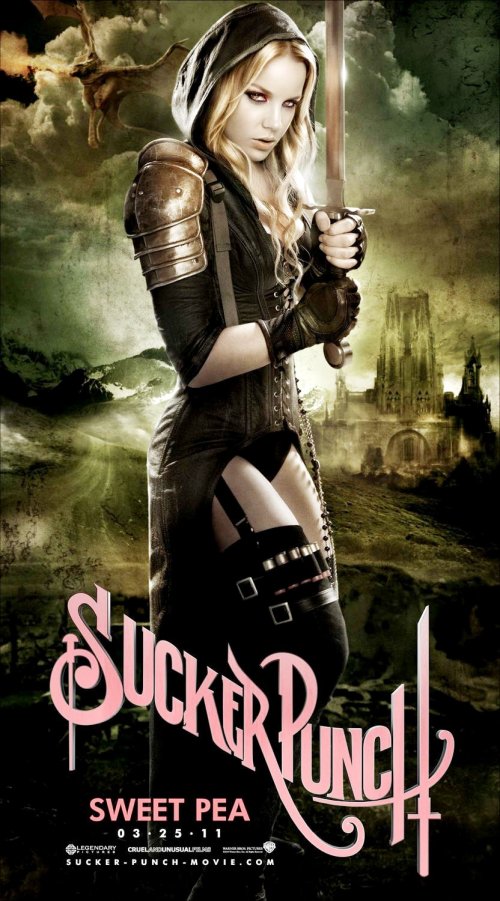
Theory 1: The main character of this film is actually Sweet Pea. Baby Doll helps her escape, and Sweet Pea is able to start a new life.

Theory 2: Baby Doll and Sweet Pea are aspects of the same person.

Arguments for 1:

The movie opens with a narration by Sweet Pea, leading us to believe it’s her story. She tells us that angels may come in any form, including little girls (i.e. Baby Doll), but that they’re not here to fight our battles. They’re here to help remind us that we control the worlds we create. Baby Doll is Sweet Pea’s angel, and when she arrives at the asylum, her impending lobotomy reminds Sweet Pea how sacred a place the mind is, and she uses this newly rediscovered knowledge to create an imaginary world she can retreat to during her escape attempts so that fear doesn’t overtake her.

The entire burlesque layer is Sweet Pea’s creation, which makes sense, since Sweet Pea is the main dancer. We’re all the main characters of our own imagination. The question then becomes why we get a battle that contains only Baby Doll when she’s fighting those robot samurai. It’s a valid concern, but perhaps Sweet Pea is simply entranced by Baby Doll’s dancing and chooses to imagine it as a battle. If that’s true, why is it Baby Doll who meets the old man and comes up with the plan? Maybe Baby Doll really did come up with the plan, and to give it some more credence, Sweet Pea inserts a wise man into her imagined version of Baby Doll’s story.

What’s happening in the asylum this entire time? Baby Doll is brought in, rebels, and comes up with a plan. Her dancing might represent fits of mental breakdown, minor attempts at escape (like fighting guards or running through doors) or even actual dancing. But no matter what it represents, it’s powerful enough that Sweet Pea must fit it into her imaginative storyline.

Sweet Pea escapes. When we’re finally in reality at the end of the film, the female doctor tells us that Baby Doll caused quite a bit of trouble, including helping a patient escape. We should believe any information that’s actually presented in reality, for there’s very little of it. If a patient escaped, it only stands to reason that it was Sweet Pea, for she’s the only one who comes close to escaping in any of the imagined layers.

But if she really was set free, then why does the last scene look so imaginary. Whenever we transfer to another layer of reality, the camera starts on Baby Doll then does a 180º spin. In the last scene, Baby dolls closer her eyes, the camera spins, then we see Sweet Pea meet a bus driver who is none other than the wise man. If this is supposedly real, then how did any of the characters know the bus driver well enough to insert his face into their imagination? She couldn’t possibly have met him before, could she? And why did the bus driver lie, saying that she’d been on board the whole time so that the cops didn’t question her? It all seems a little convenient. Isn’t it more likely that Baby Doll is simply imagining this as well?

Arguments for 2:

The last scene of reality at the beginning of the movie is Baby Doll lying down in the doctor’s chair, about to receive a lobotomy. If we’re seeing this scene, it only stands to reason that Baby Doll has already failed to escape and we’ve reached the end of the film. In the next scene, Baby Doll wakes up in the burlesque layer, only it’s not Baby Doll. It’s Sweet Pea in the exact same position wearing a blonde wig.

Baby Doll receives the lobotomy, and her last shot at survival is to retreat into her mind where she creates Sweet Pea, the sexy, confident dancer. The rest of the film only covers a few seconds in real life, the small amount of time it takes to perform a lobotomy. In that time, Baby Doll fantasizes an entirely different situation and an escape, and as she loses her mind, the burlesque layer becomes even crazier, slipping into the crazy battle scenes we saw earlier. In this reading, we no longer have to try to match the fantasy imagery to the layer of reality, for nothing is actually happening in reality.

By sacrificing herself to help Sweet Pea escape, Baby Doll is able to find solace, realizing that though she, the physical version of herself, may not make it, Sweet Pea, Baby Doll’s imaginary self, is free, unable to be harmed by the cruelty of the world. Sweet Pea is Baby Doll’s angel, whispering the reminder that we have power over the world we imagine, and in that world lies freedom. If this is true, then who actually escaped? The doctor says someone did, so it must have happened. In this reading, we’re required to assume that we don’t know who actually escaped, just that it happened.

Also, if the whole film is simply a few seconds of a mind’s last thoughts before being erased, then how do we explain the other information the doctor gave us and its relevance to the movie. She tells us that Baby Doll started a fire and stabbed someone, actions that directly link to the fantasy world. Is it possible she accomplished all that in the 5 days before the lobotomy, including helping someone escape, and that we didn’t see any of it? That the movie flashes forward to the lobotomy, and we get to see Baby Doll’s twisted, imaginary version of the previous 5 days? That’s what I think.

What do you think? Who teaches us what’s real and how to laugh at lies?

Written by Russ Nickel
95 Comments

Filed under Opinion

Sucker Punch – Mindbending and Awesome

Reality is a prison. Spring break 2011: trapped on the island of O‘ahu. The streets overflow with prostitutes, the destitute denizens of a corrupt city. I stand on the balcony of my hotel; below me, a fight breaks out, and soon cops flood the scene. Desperate to escape, we drive to the theater, situated between an abandoned warehouse and a broken-down cannery. We see some mountainous Samoans, tattoos rippling along their muscles as they load pieces of bikes into a truck. Undaunted, we ask them about parking—

Wake up. Somehow, this place is a penitentiary no longer, though it’s still not without its trials. Inside an IMAX theater, we take seats on the stairs, all too aware of the glares of those around us, disdainful of our audacity. Theater employees walk into the room and head toward us, grim looks of duty spreading over their compassionless faces—

Overwhelmingly loud music, images so forceful they tumble from the screen. Suddenly everyone is gone and I’m alone, drawn into the movie, disconnected from pain and worry and self.

That’s basically how Sucker Punch worked. The film starts off with an incredible sequence entirely devoid of dialogue (my second-favorite opening in recent memory—right after Star Trek). The music pounds with a driving rhythm, and Zack Snyder’s signature slow-mo is used to great effect. The artistic style is stunning, and some of the crystal clear IMAX shots are beyond entrancing. I was immediately sucked in, and I simply wondered how long the movie would be able to sustain my adrenaline-fueled sense of total immersion. The answer was “the entire time.”

At the beginning, Baby Doll’s (Emily Browning) mother dies, and when her stepfather receives nothing in the will, he turns murderous. In an attempt to defend herself and her sister, Baby Doll shoots her stepdad but only clips him, and somehow her sister ends up dead. Things look grim for Baby Doll when she’s committed to an insane asylum run by a corrupt doctor who agrees to have her lobotomized so she can never tell her story. She lies down in the doctor’s chair and—

Wakes up. After that, none of the remaining scenes take place in reality until the last five minutes, and the rest of the time, it’s up to you to use your imagination to fill in what’s happening. So if you didn’t like it, it’s clearly because you’re uncreative (winky face). But seriously, while some films may be a metaphor, this is one in which every single scene is metaphorical, and the task of deciphering their meaning is placed on the audience.

Like Inception, this movie takes place in layers of reality. The lowest layer is the insane asylum. Then comes the imaginary world in which all the mental patients are dancers in a burlesque house. This world mimics the asylum in ways that are relatively easily linked, but the layers don’t stop there. Any time there would be a scene of conflict, drama, or action, instead of actually seeing it occur, we are whisked away to a chimerical world of pure fantasy. For those of you who doubt Zack Snyder’s screenwriting ability or level of intention, there are a few scenes that make it clear we’re supposed to read deeply into this layer system. At one point, Baby Doll is dancing in front of the cook, but some water is spilled, and it’s slowly flowing toward the radio. In the battle layer, the girls are trying to disarm a bomb, and some high-tension intercutting lets us know that if that bomb goes off, it’s equivalent to the water shorting the electricity. The way the stakes are heightened in one level through what you see in another level is an undeniably creative conceit that, in my opinion, was executed nearly flawlessly.

But don’t worry. This movie isn’t some plodding allegory that exists purely to enlighten us. It’s got more eye candy than a deranged, cannibalistic optometrist confectioner’s sweetshop. The cast is composed entirely of beautiful women, and as if that weren’t enough, they’re clad in sexy schoolgirl outfits in the burlesque layer, and during the battle sequences, they don hot femme fatale outfits and run around firing guns and wielding swords. What’s not to like? And my sci-fi and fantasy desires were more than sated. First we get to see a martial arts fight against gargantuan robot samurai with spears and Gatling guns; next a WWII battle against zombie steampunk Nazis that plays like a level of “Call of Duty”; then a fantasy castle siege in which the girls have to slay an army of Orcs, only to face a powerful, fire-breathing dragon; and finally a futuristic sci-fi thriller sequence on a high-speed train filled with robots guarding a ticking bomb. This movie was a combination of all the best action scenes from all the best genres, and it wove them together under the veil of a psychological mind-bender.

All the while, the film was artsy and stylistic, epic, and driven by a soundtrack so compelling that I downloaded it as soon as I got home. If you approach this film with the right mindset, you’ll be blown away. Make sure to see it in IMAX, because it’s imperative that your senses be bombarded as overwhelmingly as possible, and don’t forget that it’s up to you to decide what happens.

4.5/5¢

Despite all the layers and metaphors and everything, the most confusing thing about this movie is the title.

Written by Russ Nickel

3 Comments

Filed under Review

Scott Pilgrim vs. the World Review

The fact that Scott Pilgrim vs. the World is a movie at all is a feat unto itself. A simple plot summary is likely to elicit blank stares from anyone unfamiliar with the books:

Twentysomething slacker Scott Pilgrim doesn’t have much going for him other than his crappy garage band and his high schooler girlfriend when he meets (literally) the girl of his dreams: Ramona Flowers. He falls head over heels for her, but there are complications. He has to defeat a league of her seven evil ex-boyfriends.

Author Brian Lee O’Malley renders his book in dynamic cartoon visuals and uses symbols from video game culture for both humor and narrative effect, but it’s not something that easily translates into a mainstream big-budget movie flick. But strong source material goes a long way, and so despite its flaws, Scott Pilgrim succeeds.

Most of the time, Scott Pilgrim is hilarious, giddy fun. It’s funny, really funny. Quite a lot of the original dialogue (which was what made much of the book so enjoyable) has been maintained, and the video game CGI elements connect effortlessly with the rest of the picture. The visuals are beautiful and visceral, though at times they border on being too happy and colorful, undermining the more serious themes at play. The artistic directors would have benefited from a more varied palate.

Director Edgar Wright is an excellent choice for such a plot-heavy ADD epic. The signature quick cuts that characterized his work in Shaun of the Dead and Hot Fuzz are reincorporated en force, and scenes change mid-dialogue without missing a beat. It’s a source of humor and also a way of reflecting Scott’s own confusion.


Michael Cera is surprisingly good as the titular protagonist. He holds the perfidious title as the prototypical indie hero with all the backlash that invites, and his “star power” could have easily engulfed Scott Pilgrim and turned him into a blank-faced dope. Instead he shows off more versatility than he has in anything since Arrested Development, and while his performance doesn’t soar, at least it doesn’t destroy the movie as it could have. More impressive is Kieran Culkin, who plays Scott’s gay roommate Wallace with a reserved, dry wit.

Part of the problem with Scott Pilgrim is that it starts off at a run and never slows down. If they had spent a little less time on cartoon fights we might care a little bit about whether or not whether Scott gets the girl in the end (or which girl it ends up being). The second half of the film is  a relentless series of battles, and the emotional crux of the story isn’t addressed until the climax. The tension leading up to that point feels entirely unearned.

Like all film adaptations, the restrictions of the medium lead to compressions of plot. This is understandable and unavoidable, but unfortunately is done at the expense of character development. Side characters are reduced to nothing more than stereotypes with clever lines, and the evil exes are nothing but bosses to be defeated. The film could have (as the comic does) given the reader an idea of these character’s lives outside of their relationship to Scott, but they don’t. Worst of all, Ramona herself is reduced to a prize, a Princess Peach held captive by a hipster Bowser.
As a result, the nobility of Scott’s video game quest is never challenged, which borders on unforgivable. A major aspect of the book is Scott’s dickish behavior. He’s selfish and thoughtless, and his actions hurt a lot of people throughout his life. By contrast the film devotes little time to Scott’s internal struggle. There’s no examination of his integrity or his motivations. While the comic used the cultural currency of its audience for a compelling examination of relationships, the film takes the video game metaphor at face value and turns it into a shiny veneer on another typical love story.

3/5 Stars

Overall assessment: Fun, but they should have spent more time on the script.

Leave a comment

Filed under Review

Battle: Los Angeles – Marines vs. Aliens (Starcraft, Anyone?)

And then they die, just like that. At first you think a reasonable number of the characters will survive, but like I said, this movie is all about the intensity, and it keeps you on the edge of your seat no matter what. Suddenly aliens are storming into the building, swarming the characters with superior tactics and tech. Gotta get the kids out, but they’re everywhere! How do they even kill these things? Nantz cuts one open to find its weak spot but it’s like their tech has been grafted to their muscles. How the hell do you kill them?!
Six Paragraphs Earlier:

If there’s one thing that keeps me up at night, it’s fear of an alien invasion. That, and copious amounts of caffeine, the lure of videogames, and pretty much anything else, but mostly it’s the fear. That’s why I was so excited to have a marine move into my apartment with me. I figure marines are pretty badass, so with him around I could sleep easier. My excitement quickly dwindled, however, when I realized how much exercise he was going to make me do. Running every day! Plus all sorts of pushups and marine-type body-destroying things that make me hurt everywhere.

It’s all worth it though, for the protection. Only problem is, he’s the kind of marine who paints picturesque ocean views and studies vocabulary of his own volition and likes to debate philosophy, all while steadily improving his culinary skills. If we needed someone well-versed in philosophy to use grandiloquent rhetoric to persuade our malicious invaders of the immorality of their actions, I wouldn’t need marines. I could just do it myself. If we need to shoot them in the brains, I’m willing to step aside and let someone with training go ahead and do that. Thankfully, the marines in the movie were much more battle-focused than the one in my apartment.

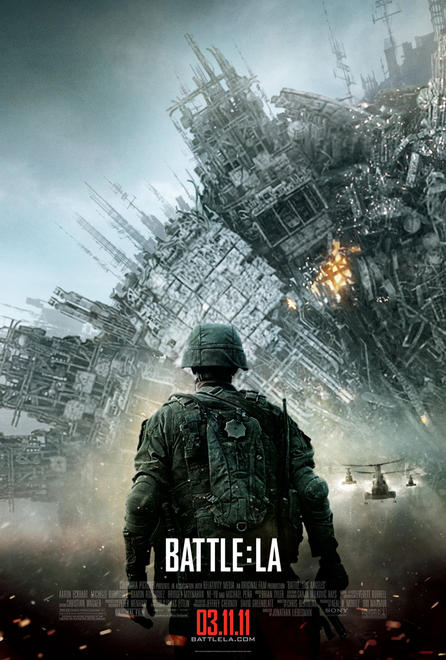
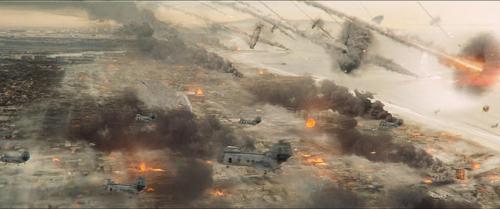
One of the coolest parts of Battle: LA is its opening. It starts in medias res, which kicks off the action with extreme intensity. A newscast plays over the opening credits, then there’s a cut to shots of LA being blown the hell up. A military leader explains that we’ve lost San Francisco and San Diego, and Los Angeles is America’s last line of defense in the west. It cannot be overrun! Then suddenly the main characters are in a chopper, heading for the front lines, under heavy fire, with people dying everywhere. I knew Battle: LA was going to be all about war, but I didn’t think they’d go so far as to skip characterization completely. To be honest, I was excited. I’d never seen a movie do something like this before, and if they could keep up that palpitating level of pure intensity, I’d be hooked.

Sadly, it quickly flashes back to 24 hours before the attack and goes through all the standard character intros. They’re made even more standard thanks to how little time is spent on them. SSgt. Michael Nantz (Aaron Eckhart) is the only one who becomes any sort of relatable. Every other character gets about 1 paltry minute of humanizing screen time, but there are so many marines in the troop that your eyes just glaze over while you wait for more action. After five minutes, I couldn’t have matched a single character to his backstory if my life depended on it. But who cares? It’s a war movie!

And war it does well. Around every corner lurks danger, each consecutive moment ushers in new fear, and after the first few deaths, I realized no character was safe. It’s the intensity that makes this movie worth watching. People die bravely, and people die for no reason other than bad luck; some die after heart-wrenching monologues, and some die without warning. People receive injuries, show great heroism, yield to their cowardice, and generally run the gamut of war-time emotion. The moments when two characters look at each other knowing that one is about to sacrifice himself are truly compelling, and there are more than a few poignant speeches. They may not have good backstories, but sheer adrenaline makes you care for these guys.

The set pieces and general look of the film elevate these scenes to an even higher level. The camerawork is anything but smooth, so you feel as if you’re running right alongside the marines. And Los Angeles looks like a battlefield. Fights break out in suburbs, on broken-down freeways, and, at one point, in a dimly-lit police station. The sense of fear really starts to mount as Nantz investigates alien anatomy, searching for a weakness while a select few marines are ordered to hold off the inhuman enemy. You think they’re gonna do it…

And then they die, just like that. Suddenly aliens are storming into the building, swarming the characters with superior tactics and tech. How the hell do you kill them?! The aliens are hard to kill, but the fact that they’re aliens hardly matters. Science fiction really takes a back seat to what is essentially a movie about a small troop of men facing overwhelming odds. In fact, the aliens get basically no story time at all. This is no Independence Day, what with that alien that takes over the scientist and speaks through him. Battle: Los Angeles is much more realistic and not nearly as light-hearted.

Not everything works, however. There’s a subplot about all the men distrusting Nantz that feels totally superfluous. Anyone with half a brain can tell that Nantz is probably the best guy in the world, so when they finally all come to terms through a heartfelt speech, it doesn’t jive.

The movie knows what it is: an explosive war story. It focuses on a small group, builds intensity until you can’t take it anymore, and delivers on sweet action.

Score: 3.5/5 ¢

Alignment: Spectacular Fluff

Oh and:

Michelle Rodriguez was sexy and badass, killing aliens all over the place and looking hot while doing it. She’s pretty much always the same character, isn’t she?

Epic F-Bomb usage, and in a PG-13 movie, you’ve got to make it count. During the final battle, Nantz says, “Marines, we make our stand right here. Let those bastards know who they’re fucking with.”

Written by Russ Nickel

Leave a comment

Filed under Review

The Adjustment Bureau – Angels, Doors, and Boredom

(Warning: The following may and does contain SPOILERS)

Have I sinned? Is it thanks to some flaw in my character that I was led to The Adjustment Bureau? Or did sitting through the movie simply cause the fewest ripples? I tried to avoid it; I did—but every conflicting event was canceled, every excuse invalidated. I didn’t have a ride, then someone offered to drive. I was too hungry, then a stranger handed me a burrito. I had to finish building a machine that could drill to the center of the earth so I could set off some nuclear bombs and restart the spinning of earth’s core, then I realized that didn’t make any scientific sense! After so many small miracles, I knew I couldn’t avoid my fate any longer. I had to go the movies.
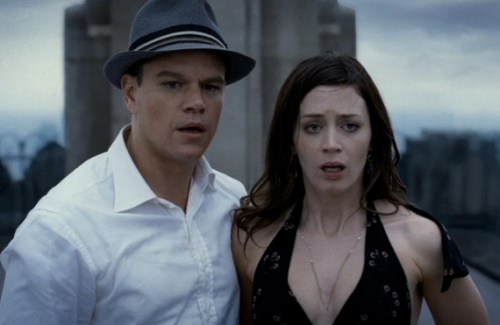
It wasn’t an altogether pleasant experience. The car seat had left a sticky residue on my pants, the burrito was vegetarian, and I kept worrying that the world was about to end, but worst of all was this persistent feeling that I’d been tricked. Twice in the last month I’ve ended up watching romance movies. And I never watch romance movies by accident. Because if I do, I don’t remember to bring tissues for my tears, and my face just ends up a total mess. I Am Number Four looked like an epic superhero movie, so I went, only to find myself stranded on a small island of CG in an ocean of emotion. The Adjustment Bureau was no better. What looked like a supernatural thriller starring Jason Bourne was nothing more than a tale of bittersweet love covered in a deceptively crunchy shell of conspiratorial candy coating.

I suppose bittersweet isn’t all bad, though—useful for baking. Anyway, Matt Damon stars as David Norris, an up-and-coming politician with a pretty face and a promising future. He loses an election and is on the verge of also losing hope when he runs into Elise Sellas (Emily Blunt) in the bathroom. It’s love at first sight. Her carefree attitude inspires him to give a heartfelt speech that wins over the public. By chance, he later runs into her on a bus, and things are looking great. The only problem is, he was never supposed to see her again.

The Adjustment Bureau knew David needed a nudge in the right direction so he wouldn’t give up, and they chose to use Elise, but they weren’t meant to be together. That goes against the Bureau’s plan, and it’s up to the agents to make sure everything goes according to plan. That’s right. There’s a secret world of agents running around the world mapping out our lives for us. The plan is God’s work, and these guys in suits are angels, and, you guessed it, there’s no such thing as free will. But love conquers everything, even God, so David sets out to prove he has free will, overcome the administrative powers of the seraphim, and tell God to suck one.

The setup is full of fate vs. free will potential, with plenty of room for conspiracy and action, but that setup is all it is. The movie never really delivers, choosing instead to spend lots of time on the love story and long-winded explanations of the workings of the Bureau. Nothing particularly exciting ever happens, save for one scene of David running from the agents. Plus there’s a bunch of arbitrary rules tossed in that reek heavily of plot device and rip you out of the flow of the film. Angels wear hats that allow them to make doors lead to distant locations. Hats?! Oh, and certain doors connect to specific other doors, so the angels have to spend a lot of time memorizing the “substreets.” This leads to the comedic line “I hate downtown.” Yeah, it gets a laugh, but really it’s just pointing out the absurdity of these arbitrary plot conventions. Turn a doorknob right and you jump to the next place. Turn it left and you meet God. And for some reason, angels are weak to water.

The Bureau’s limitations are silly, but so are their conventions. Each agent is only allowed to make so many minor changes, because after that, the effects, or “ripples” become too great, but we see one angel cause series after series of car accidents. If we start to imagine the butterfly effect, even the smallest change will have huge repercussions, and something like a car crash is really gonna fuck someone’s day. I mean, imagine. You’re driving to work, then boom! Angel messes you up with his magic. Suddenly you’re in the hospital and your wife has to leave work to come meet you. Her friend has to take over her shift, meaning she can’t go out on her blind date. It falls through and she ends up with some low-life and they give birth to Hitler 2.

Ok. Ok. People have told me that I tend to read way too heavily into the science fiction behind these love stories (read: The Lake House—basically time-travel vomit), so I think maybe I’m being a little harsh and I try to keep an open mind. I’m sitting back, trying to enjoy myself, when out of nowhere the movie tells me that the characters aren’t really in love anyway. They slap you right in the face with it. The agents explain that the only reason David and Elise love each other is because they were supposed to end up together in an earlier version of the plan! Suddenly the film isn’t about love conquering everything or even free will vs. predestination. It’s about David accidentally stumbling onto an outdated version of his fate because the agents made a mistake. It completely eviscerates the entire romance. And it’s not even revealed as a twist; it’s just mentioned in passing like it’s no big deal, but I mean, what am I supposed to be rooting for? For the beta version of the plan to win? For David to literally reach God and beat the crap out of him? Actually, that would be pretty sweet. Could be some hardcore, supernatural action sequence.

Oh well. I suppose it’s not my place to question God’s plan, for as we all know, the best laid schemes of mice and men go often askew, and leave us nothing but grief and pain. But you know whose plan I can question? The screenwriters, because this movie could use some serious adjustment.

Score: 2.5/5¢

Hats?!

Written by Russ Nickel

Leave a comment

Filed under Review

Paul Review

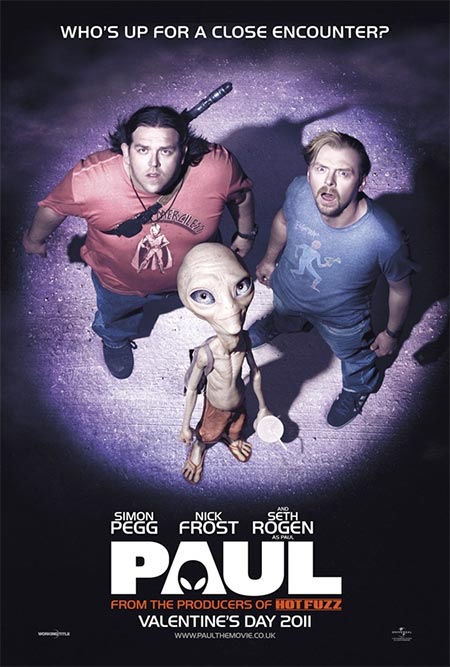
About halfway through the second act of my pre-screening of Paul there was a sound error, and the dialogue and soundtrack of the movie became accompanied by a sort of droning, thumping, static sound. At first we thought it was part of the film, but after a few scenes without any justification we determined otherwise. The sound continued unabated for about half an hour, sometimes growing so loud that it was actually impossible to tell what the characters were saying. This might have been a problem, but I found that with Paul, it didn’t actually matter much. No one was saying anything so complicated that it couldn’t be deduced though body language and context. It’s too bad, because Simon Pegg and Nick Frost’s previous works (Shaun of the Dead and Hot Fuzz) both demand to be torn apart word-for-word to root out all the layers of comedy. Paul ditches the high-concept premise and instead becomes a crass homage to science fiction movies without ever being more than a momentary distraction.
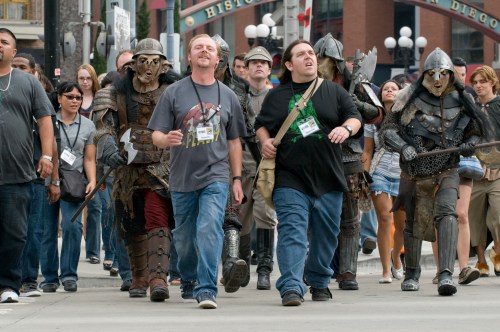
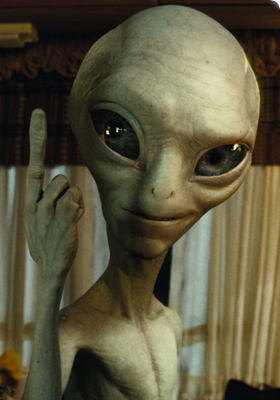
Paul begins at San Diego Comic-Con, the first of its many fan services. Graeme and Clive (played by writers Pegg and Frost) are on vacation and taking a road trip to see all the famous UFO sightings in America. Instead, an actual alien crashes a car in front of them. Paul, a wise-cracking little green man, greets them with a snide remark and quickly convinces Pegg to drive to a remote location in Wyoming so that he can get back home. From there the film becomes a race to the finish line, with special agent Jason Bateman hot on Paul’s tail. Various events occur before the end of the movie; we meet Kristen Wiig as a one-eyed Bible-thumper who abruptly becomes a scientific objectivist after Paul uses his convenient healing powers to fix her eye and transfers his collective memory to her brain (don’t ask). Then there are some explosions, some pathos as Paul apologizes to an elderly woman for accidentally killing her dog in the prologue, and then everybody’s running to Forest Clearing A, where Paul uses some store-bought fireworks to signal a mothership the size of New York City. Sigourney Weaver cameos as the villainess, because she’s like a sci-fi staple now, and Paul saves the day by reincorporating his well-established healing powers.

I don’t really know where to start with this movie. I’m really disappointed in Pegg and Frost, who I thought were a lot smarter than this. Compared to their previous work, Paul flat-out sucks. There’s virtually no character development between anyone. Peripheral characters are either unfunny stereotypes or just unfunny. The writing feels bland and lazy, so much so that the same “joke” will be repeated three times with the only variation being that a different person said it at a different time. It doesn’t help that the film’s definition of a jok is creative profanity. The flimsy plot, which never gets beyond a manic “escape the baddies” chase, makes sense only until you actually scrutinize it, upon which it collapses from its own weight. And while the film heaps on the nerd homages, as a science fiction story it’s embarrassingly short-sighted. There’s potential in the script for something worth watching, but they never got past the first glimmer of an idea.

That’s pretty much all you need to know. I’m going to go in depth to the above points, so if you’re not interested in the process just skip to the bottom where I’ve conveniently distilled the film’s qualities into an amount of stars.

The film’s protagonist and main relationship character are naturally, Pegg and Frost. This is fine, and expected, and while it’s disappointing that Frost isn’t given the lead as was originally planned (wonder who axed that one) it’s a false distinction since neither of them really have any agency whatsoever. So they’re friends, one’s a writer and one illustrates science fiction novels. But the film is called Paul, which is neither of them, so how does he fit into the film? Well, the film tries to make him the source of conflict between them. Frost is a little more freaked out by the alien, a little more untrusting. This is kind of hard to believe because literally any nerd would gladly cut off a finger to be in his shoes, but could still work if they had backed it up with some characterization (perhaps his knowledge of science fiction leads him to be suspicious of Paul’s motives?). Instead he’s just a wet blanket. Frost comes around to Paul but becomes jealous of Pegg who, as the protagonist, gets the romantic interest. And Paul bonds with him over that, so everyone’s good and we can go into the climactic action sequence without any lingering uncertainty hanging over our heads.

I’ve compiled a theory that Frost’s character is actually written as gay and secretly pining for Pegg. There are homophobia jokes galore, enough to beg further justification. And honestly, it would completely explain Frost’s resentment and complaints that the trip was supposed to be “just the two of them.” It would even resonate with the themes of fraternal geek culture that Paul tries so hard to embody. But in the end that possibility is left unresolved. I wouldn’t be surprised if that was written in and then cut by the producers for being too “controversial”. I guess nerd audiences are okay with jokes about being perceived as gay, but to actually have a gay character (excluding the self-proclaimed bisexual Paul) would hit too close to home.

Pegg and Frost clearly had something going on with this nerds-encounter-an-alien plot. It has all the elements of their previous genre-bender films, only this time for science fiction. There’s even a formula for us to follow. At first common tropes are undermined amusingly, but they are eventually embraced and reincorporated in the end of the film. It seems like that’s what they tried to do, but for various reasons it doesn’t work, the main one being that they don’t have any kind of investment in the science-fiction portion of the story.

Science fiction is supposed to be about speculating on the vast possibilities of the universe, and what makes a close-encounter story compelling is the chance to interact with an intelligent organism entirely different from humanity. Paul the Alien is basically your college roommate inside the body of a squat grey midget.

The explanation for why his personality is so abrasive is that he’s lived on Earth for 60 years and evidently maturity or tact are qualities less enlightened species are burdened with. His explanation for why his biology is so stereotypical is dismissed as a subconscious conditioning program dispersed through the human population over the years in order to keep humans from freaking out should they ever make contact. This does nothing to explain why he’s humanoid in the first place– I guess because the answer is, “it was convenient.” That’s the answer for pretty much every interesting question the film poses.

Why does Paul have godlike powers of healing, invisibility and telekinesis?  He’s the title character for the film, but by the end we know virtually nothing about him. We know nothing of his race, where they come from or what their society is like. All we know is that we have to get somewhere to shoot off fireworks so that the massive, invisible alien mother ship will know where to pick him up. The ship only poses more questions. Did they drive all the way from Alpha Centauri to rendezvous with Paul? Or were they always there? Are they upset that the USA was interested in killing one of their citizens to harvest its stem cells? What kind of diplomatic relations does the government have with these guys, anyways? No one knows, because the movie doesn’t bother to address any of these questions.

You might say (Russ I’m looking at you), that I’m overly scrutinizing what’s just supposed to be a lighthearted romp through some old science fiction tropes. But is it too much to ask that a film riffing off of science fiction actually do its homework? If I can come up with these few questions just sitting here at my computer, couldn’t two guys actually faced with a real-live alien do at least as well? They’re poor representatives of nerd culture if they can’t approach a close encounter with at least a hint of skepticism.

2/5 Stars

Posted by Sam Julian

Leave a comment

Filed under Review

The Nickel Awards: Part 1

In the wake of this year’s Oscars, we here at The Nickel Screen felt compelled to give out some awards of our own. All of those supposedly learned movie people obviously know nothing compared to us, so sit back, relax–actually, sit forward and pay attention. We put a lot of thought into this 3-post extravaganza, and you’d better enjoy it.

Nerd’s Fantasy Nominees: Scarlett Johansson (Iron Man 2), Olivia Wilde (Tron: Legacy), Gemma Arterton (Prince of Persia: The Sands of Time), Emma Watson (Harry Potter and the Deathly Hallows: Part 1), Rapunzel (Tangled)

Winner:

If there’s one category the Academy Awards blatantly lacks, it’s this.

Why do movies really, truly exist? To spin heart-warming tales of kings who grapple with their issues? To show people how tough cutting off your arm can be? I don’t think so. Movies exist to make money, and who has money? That’s right, nerds. We sit eternally at our computers, hiding from the day star and pitifully pecking at the keys that provide our sustenance, but you know what? We make bank.

But money doesn’t equal happiness. We understand that all too well as we sweep our gazes across our rooms, eyes alighting on our mint condition Millenium Falcon replica. It sits, dusty, right next to our extensive comic book collection. To its right, a poster of Captain Kirk looks outward, ignoring the Atari 2600 which rests just below him, unused. But we don’t see happiness. No, because happiness is more than belongings.

As The Beatles taught us, money can’t buy you love, and love is all you need. But unfortunately, no real woman can ever hope to win our hearts, for we have already fallen, fallen for the phase-shifting sublimity of Kitty Pryde, for the Amazonian intensity of Wonder Woman, and for the stripping strippiness of Stripperella. Human women be damned! If only we could somehow make these fantasy babes real!

And by god, movies are the closest thing we’ve got. If there’s one dangling carrot that can get us away from our apartments—make us sit up from the chair, change out of our pajamas, and face the daylight—it’s a film version of those girls we think about day and night. That’s why movies exist. They exist for the nerd.

This year was an excellent showing of sexy. Olivia Wilde donned a skin-tight, light-up, spandex suit, drove a futuristic light-car and kicked ass on a bunch of evil programs. Only problem was that she herself was a computer program, and that’s not really my thing. Gemma Arterton trekked through the desert as Tamina, a beautiful Persian princess who wasn’t afraid to get her hands dirty, killing a bad guy by stabbing him in the eyes with a live snake. Emma Watson continued to age, making her hotter than ever, and more legal, and Rapunzel, despite being animated, was the epitome of purity and innocence (and the only blonde, a lot of blonde).

But despite the caliber of the competition, Scarlett Johansson won out. As Black Widow in Iron Man 2, I’ll let her catch me in her web any day. By the end of the movie, I couldn’t agree more with Tony Stark’s initial reaction of “I want one.” We get to see her change in the back of a car then run down a hallway filled with nameless henchmen, electrocuting the first one and backflipping off a table onto the second, snapping his neck between her legs. By the end of the hallway, she’s killed like 8 guys, no fewer than 3 with the leg around the neck method. Please god, I know I haven’t been the perfect person, but if you can hear me, if you truly are as benevolent as they say, that is how I want to die.

Worst Nerd’s Fantasy: Hailee Steinfeld (True Grit)

Oh, and I’ve gotten some complaints about Hailee Steinfeld losing this category. I keep hearing things like “she’ll grow up,” and “standards were different in the old west,” but seriously people? I mean, I agree completely, but that doesn’t make her any less annoying.

Worst Picture Nominees: Dinner for Schmucks, The Last Airbender, The Twilight Saga: Eclipse

Winner:

I hate The Last Airbender. I hate him and his bendy friends and his stupid enemies and that weird-ass creature he rides. I loathe them all. I hate what they’ve done to my eyes. I hate the memories they’ve burned into my brain that, no matter the amount of therapy, I cannot remove. I want those hours of my life back. I want to return to a time of innocence, when I thought the world was filled with good and honest movies, that it was a place of joy and happiness untainted by the foul, festering, fetid touch of M. Night Shyamalan.

I hate The Last Airbender. There is no plot other than that which is condensed into interminable, emotionless, soul-crushing narration. There is no tension but the tension of whether you’ll be able to make it to the end without committing a gruesome, sinful, ritualistic suicide. There is no dialogue, save that which sounds as stilted as the mad gibbering of my great Uncle Wallace, whose father was a chimpanzee and whose mother fed him nothing but industrial grade turpentine. There is…nothing. No crime so heinous, no sin so foul, no soul so tainted that warrants the horrible fate of viewing the The Last Airbender. It is, without a doubt, the Worst Picture.

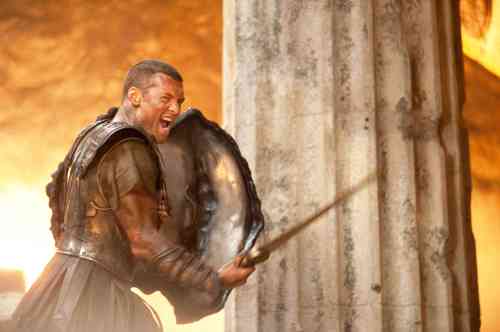
Most Epic Kill Nominees: B.A. motorcycle leap+neck break (The A-Team), Iron Man laser sweep (Iron Man 2), John Malcovich bullet to rocket launcher shot (Red), Perseus lightning sword throw (Clash of the Titans)

Winner:

Each year, blockbuster movies create increasingly evil and powerful antagonists for our heroes to face, but there’s only so many ways to kill a man. Iconic villains require iconic deaths, and even henchmen can earn some bit of glory by dying at the hands of a good guy’s masterful move. Iron Man’s sweeping laser that cuts a dozen evil drones in half (though can they really be called evil if they’re just drones) was memorable, but it invalidated all the fighting until that point. B.A. had some badass wrestler moves, and John Malkovich’s shooting a speeding rocket with a bullet required some serious precision, but Clash of the Titans walks home with the Most Epic Kill. Like I said, there’s only so many ways to kill a man, but how do you slay a god?! As Hades hovers ominously in the stormy sky, Perseus, standing atop the highest point in the city, raises his sword toward the heavens, drawing a sparking lightning bolt to the blade, then hurls it toward the god of the underworld. Lightning and sword strike the demon as one, sending him back to the land of the dead. Epic.

Best Fight Nominees: A-Team Flying Tank, How to Train You Dragon Final Battle, Inception Hallway, Scarlett Johansson Hallway, Scott Pilgrim Final Battle

Winner:

Inception’s magical world of dreams led to some iconic action sequences whose out-of-this-world physics were much better explained than in most movies. Standard action heroes seem to possess superhuman flexibility and strength for basically no reason, but because we could believe the fighting in Inception, it became much more memorable. The zero-gravity hallway battle between Joseph Gordon-Levitt and the security projections was by far the coolest thing on a screen this year. Jaded by the barrage of unoriginal action sequences that accost my eyes every year, very few things truly wow me, but watching Gordon-Levitt spin undaunted through a hallway of alternating gravity, using the fluctuations to his advantage as if it were the simplest thing in the world, that was a moment to behold.

Worst Fight: Random water benders lifting evil Zhao into air and dropping him like 10 feet

Best Line Nominees:

“Being Vegan just makes you better than most people” Vegan Todd Ingram, explaining the origin of his superpowers (Scott Pilgrim vs. the World)

“I Want One” -Tony Stark, after seeing Scarlett Johansson (Iron Man 2)

“It must be some kind of hot tub time machine…” -Nick Weber, upon realizing their hot tub must be some kind of time machine (Hot Tube Time Machine)

“Release the kraken!” -Zeus, before releasing the fuckin’ Kraken (Clash of the Titans)

Winner:

In a year with no standout line to claim a clear victory, we opted not for the powerfully dramatic nor the entertainingly epic, or even for the ridiculously bad. This year, we give the award to a line that broke the fourth wall, because we need more of this literally outside-the-box thinking in comedies nowadays. Too often, movies follow their formula, forgetting the audience that craves something inventive. Having Craig Robinson say “It must be some kind of hot tub time machine,” then turn and face the camera showed that the writers clearly understood the absurdity of the movie’s conceit but just didn’t care. It might have been silly, but it was also hilarious.

Worst Line: “Earthbenders! Why are you acting this way? You are powerful and amazing people! You don’t need to live like this! There is earth right beneath your feet! The ground is an extension of who you are!”

That was just Part 1! Click Here to Continue to Part 2: The Continuation.

1 Comment

Filed under Feature

The Nickel Awards: Part 2

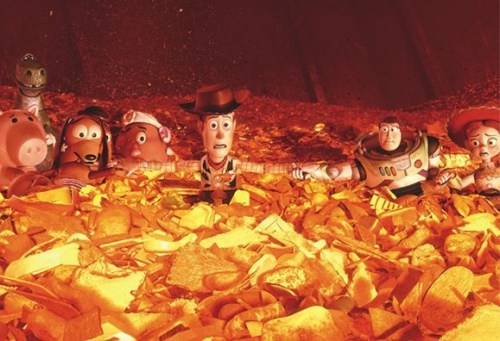
Best Scene Nominees: Cunnilingus (Black Swan), Confrontation (True Grit), Cursing Scene (The King’s Speech), Melting Scene (Toy Story 3), Ruffian’s Singing Their Dreams (Tangled)

Winner:

For best scene, we wanted to find those moments in movies that stuck with you long after you’d left the theater. There were no specific criteria, but you know the scenes when you see them. An aging teacher, coaxing a king to let fly a string of profanities. A young fourteen-year-old confronting her father’s killer. Mila Kunis going down on Natalie Portman. In the end, however, we decided to go with the climactic scene from Toy Story 3, when Woody and friends are about to be melted into indistinguishable plastic goop. One often wondered throughout the span of this trilogy of films, watching various plastic anthropomorphs undergo bizarre dismemberments and mutilations…how do toys die? Well here it is, folks: utter annihilation in the form of slow, melting torture. The moment went on for a shockingly long time, and we watched, horror struck, as realization dawned on the characters and each one accepted their death. And then at the last moment, an impossible, uplifting salvation from above. We would never have imagined that our beloved toys would be faced with such an implacable mortal peril, but the fact that it was so heart-wrenching was proof of the power of Pixar to move our hearts. Well done, good sirs. That took balls.

Worst Scene: Aang explaining to the earth benders that there was earth all around them (The last Airbender)

Best Dialogue Nominees: The King’s Speech, The Social Network,  True Grit

Winner:

It’s hard to look at True Grit in the context of the Coen’s recent triumphs such as No Country for Old Men and A Serious Man. Compared to them, True Grit is a by-the-numbers film, much less ambitious, and surprisngly simple and short. But like all the Coen’s films, it was made with a perfectionist’s attention to detail, particularly the dialogue. Not only is it historically accurate, it’s dense with characterization and flavor. Jeff Bridges is simply a joy to hear talk in his rustic grumble, and Hailee Steinfield is pleasurably precocious as a girl far more mature than her years belie. A true actor’s piece, the dialogue becomes the star of this film, revealing cultural insights and illuminating interesting power dynamics. While not a show-stopper in terms of action and spectacle, True Grit is meaty and satisfying for its brilliantly written dialogue, given to actors who know what to do with it.

Worst Dialogue: The Twilight Saga: Eclipse

Best Story Nominees: Inception, The King’s Speech, The Social Network, Toy Story 3, True Grit

Winner:

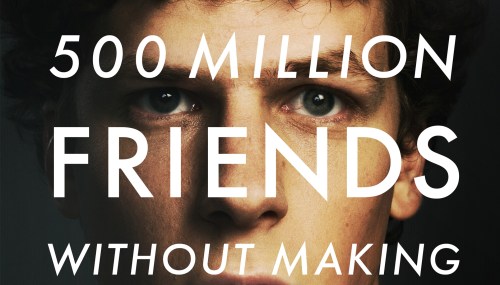
While the accuracy of The Social Network’s biographical content is clearly debatable, no one can deny that the story was compelling. We loved it for its writing and plot, the way each line worked overtime adding layers, and how every scene advanced the plot in a new, crucial way. The structuring of the film within two intense legal battles focuses themes of ownership, friendship, power and success, and its unconventional, almost anticlimactic ending has echoes of Greek tragedy. Aaron Sorkin’s dialogue may be unrealistically verbose, and at times he forced melodrama upon the story, but the clear attention to detail and overall polish make this a screenplay worth paying attention to.

Worst Story: The Last Airbender

Best Sci-Fi / Fantasy Nominees: Harry Potter and the Deathly Hallows: Part 1, Iron Man 2, Inception

Winner:

With Inception, we reached new depths of science fiction invention. Dreams within dreams within dreams, all linked together—a matrix where only some are aware, a crime scene that leaves no evidence, an idea that stunned the world. This concept created unforgettable sets set in zero gravity, arctic fortresses, and, of course, “Limbo.” For days, the world spoke of nothing but unraveling the mystery and the science behind this mentally stimulating film. We watched over and over again, picking out every detail: the ring, the music, the top.
Christopher Nolan gave us what we’d all been dreaming of: great science fiction.

Worst Sci-Fi / Fantasy: The Last Airbender

Best Comedy Nominees: Easy A, Hot Tub Time Machine, Scott Pilgrim vs. the World, The Other Guys

Winner:

2010 was a particularly weak year for comedies, but Scott Pilgrim vs. the World displayed a very special brand of humor that wryly embraced the hypersaturated modern sensibilities, riffing off of indie music, video games, and awkward relationships. Though Michael Cera probably wasn’t to best choice to play this movie’s eponymous hero, the clever script, snappily edited by the talented Edgar Wright, kept the laughs coming steadily throughout the film. While 3rd act sloppiness and some apparent last-minute rewrites prevent this film from being a classic, we at The Nickel Screen think that this was the funniest and most original comedy to hit theaters this year.

Worst Comedy: Dinner for Schmucks

Best Drama Nominees: Black Swan, Shutter Island, The King’s Speech, The Social Network, True Grit,

Winner:

While we may have a flare for the dramatic, dramas themselves are not our strong suit. I tried to watch 127 hours on a plane one time, but my headphone jack was broken. And nobody even got close to making it to The Fighter, but we saw a few, and while they all had virtues that spoke for themselves, The King’s Speech rose above the rest.

The Social Network and True Grit had undeniably excellent acting and dialogue, but in the end, neither was as rousing as George VI’s change from stammering duke to dominant sovereign. Colin Firth and Geoffrey Rush played off each other perfectly, the plot was well-paced, and the story was riveting.

So Much for Part 2! Click Here to Continue to Part 3: The Culmination.

1 Comment

Filed under Feature

The Nickel Awards: Part 3

Best Directing: Black Swan (Darren Aronofsky), The Social Network (David Fincher),  The King’s Speech (Tom Hooper), True Grit (Ethan Coen and Joel Coen)

Winner:

Best Directing is a tough award to determine, because even though a director might have their fingers in every part of a film, it’s not always clear whether credit is due to them or the hundreds of people that work under them. We chose Darren Aronofsky for his work on Black Swan because, of all the directors, his personal mark was apparent throughout the film. Because of its focus on the creative process, Black Swan seemed more intensely personal that any of the other nominations, which were excellent but straightforward stories. The nod goes to Aronofsky because the story of Natalie Portman’s tortured ballerina is told as much through the camera work and the editing as it is through plot.

Worst Directing: M. Night Shyamalan (The Last Airbender)

Best Animated Feature Film: How to Train Your Dragon, Tangled, Toy Story 3

Winner:

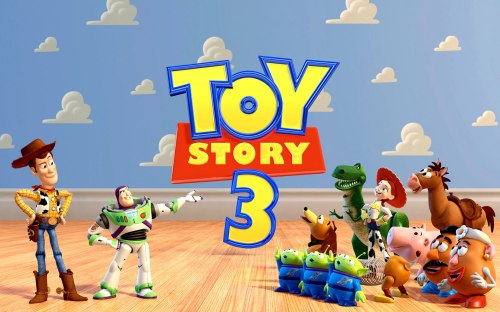
Unlike their live-action counterparts, animated films are usually a little more, well, animated. High energy, fun, and light-hearted, these movies exist to make people happy, but that in no way lessens them. Toy Story 3 is just as poignant and heart-wrenching as any film this year, and it’s made better by its wide appeal. How to Train Your Dragon threw us into a world of dragons and created the cutest creature ever. Tangled brought us back to the Disney of old, singing us a charming tale of romance. These three films were some of the best animated features to date, but Toy Story 3’s snappy dialogue, ceaseless humor, and perfect pacing, not to mention its wild emotional swings, make it the best animated film of the year. Honestly, who could resist Buzz’s Spanish setting?

Best Supporting Performance Nominees: Andrew Garfield (The Social Network), Geoffrey Rush (The King’s Speech),  Matt Damon (True Grit)

Winner:

Geoffrey Rush’s performance in The King’s Speech was simply sublime. His portrayal of failed Shakespearean actor turned elocutionist Lionel Logue was a delight to watch, his pleasant attitude masking a deep-seated determination. Rush was able to conjure up many laughs throughout the film, and yet his was also a deeply moving character, drawing us seamlessly into the king’s plight. Seeing him treat the king as an equal—making him swear and do silly vocal lessons—was just as excellent as watching his interactions with his family, be they acting out plays for his sons or hiding the truth of who he was training from his wife. In my opinion, Geoffrey Rush stole the show, even from a supporting role, and proved yet again how truly talented he is.

Worst Supporting Performance: Dev Patel (The Last Airbender)

Best Lead Performance Nominees: Colin Firth (The King’s Speech), Hailee Steinfeld (True Grit), Jesse Eisenberg (The Social Network), Natalie Portman (Black Swan)

Winner:

There are those who would argue Darren Aronofsky’s schlocky ballerina psych-thriller is not a great film, and they would have plenty of ammunition. But Natalie Portman’s incarnation of protagonist Nina is indisputably flawless. Though her character is thoroughly unlikeable, the audience still finds themselves reeling from Portman’s relentless disorientation, fear, and brittleness. Her confusion and her apprehension chill us so that we the audience tiptoe like our fragile star through the plot.

“Stop being so fucking pathetic!” Vincent Cassel’s instructor shouts at her, finally giving voice to the audience’s sentiments in the first act. Portman’s exquisite weakness is intentionally what makes her so ugly in the film, so repulsive. But as her mind and body come apart in the film’s acceleration, Portman imbues her character with a haunting and resounding spirit. That transformation is so believable in Portman’s face that one almost forgets the incredibility of the plot. Even beyond this, Portman communicates the underlying fear that lingers behind the mask of the Black Swan.

And the scene in which Portman calls her mother after getting the starring part–we dare you to name another actress in her generation who can display that level of genuine emotional complexity. Congratulations, Ms. Portman.

Best Picture Nominees: Inception, The Social Network, The King’s Speech, Toy Story 3, True Grit

Winner:

Even though year after year we face the stifling wasteland of unoriginality, even though most films are born only to die a quick death, crippled by their lack of creativity, even though Hollywood’s fear of greatness keeps new ideas mired in the backwaters of production hell, even though all we see is sequel after sequel of popcorn-selling eye candy, I still had a dream.

I had a dream that one day someone would rise up against the confines of Hollywood orthodoxy and say “enough is enough.”

I had a dream that one day in the deserts of Southern California, sweltering with the heat of bureaucracy, writers and producers would sit down at a table of imagination.

I had a dream that one day movies would be made not because of the marketability of their branding, but because of the character of their content.

I had a dream…fulfilled.

Hollywood’s been looking increasingly weary this year, and in case you haven’t noticed, they’re all out of good ideas. But a welcome break from the churn of vampire-robot-action was Christopher Nolan’s Inception. Not only did Inception exceed every action film to have been released this year, it revealed the very structures by which our thrillers are created. In fact, it can be read as a meta-commentary on the nature of film itself. By incorporating filmmaking techniques into the structure of the story (with its random setpieces, effortless culmination of tension, and possibly untrustworthy protagonist), Inception became an action movie that was its own formula. At the same time, it offered a compelling love story, a thought-provoking concept, and bad-ass action, all wrapped up in one incredible movie. Inception immediately became one of our favorite movies of all time, and we predict that it will be appreciated for its many many layers for years to come.

The End!

There you have it. Those are our picks for 2010. From all of us here at 5¢S, we sincerely hope you enjoyed your time here at The Nickel Awards.

2 Comments

Filed under Feature

Unknown – Liam Neeson vs. a Taxi

And no, I know what review this is.

Unkown and I have a special bond ’cause I had to deal with real life fear while I was watching it. When I entered the theater, I made strong impressions on a lot of the employees, striking up all sorts of random conversations, but what I didn’t tell them was that I had plans to do the unthinkable: I was going to movie-hop. As The King’s Speech drew to a close, I thought I could surreptitiously kill some time by waiting until the end of the credits, but suddenly an employee was there, cleaning, getting closer. I had to get out, but there were still twenty minutes before Unknown started.

I sneaked past all the same employees I’d befriended, pulling my coat up over my face to avoid being recognized on my way to the bathroom. Every face was that of an enemy. I didn’t know who I could trust. Any random viewer might rat me out to the authorities, having seen me leave The King’s Speech. I made it back to my seat, and soon enough the trailers began. I tried to enjoy the movie, but I was on edge the entire time. What if I got caught? What would happen when I left a full four hours after I’d arrived? Every scene was made more tense by my beating heart, so for me, Unknown was an incredible thrill. For my friends, however, it was simply “meh.” Too bad they’re not the ones writing the review!

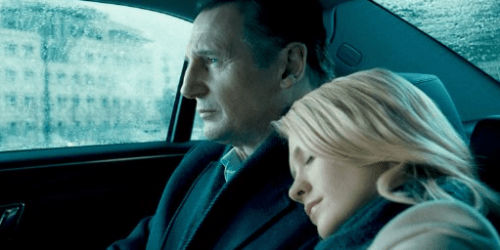
Dr. Martin Harris (Liam Neeson) is on a plane with his wife, Elizabeth (January Jones, whose name is as hot as she is), on their way to Berlin. When Harris accidentally leaves a suitcase at the airport, he sends his wife to check in to the hotel while he rushes back to get it, but on the way, his taxi crashes off a bridge. Next thing he knows, his wife has no idea who he is, and to make matters worse, she’s with another man who claims to be Dr. Martin Harris. It’s an exciting setup, and the film does a great job capitalizing on it.

It’s normally hard to review a movie that relies on mystery and revelation, since I don’t want to give too much away, but luckily there were misdirections everywhere, so it would be hard to pick out what’s actually true anyway. Think about the usual explanations for psychological thrillers in which the main character doesn’t know what’s going on. Wake up and it’s all been a dream? Actually crazy the entire time? Some sort of advanced scientific experiment? A giant government conspiracy? The writers doing heavy-duty hallucinogens when they came up with the idea?

Unknown leads you down pretty much every one of those paths. Dream? Check. Liam Neeson’s character, Dr. Martin Harris, is in a coma for four days. Crazy? Check. Even Harris’s wife doesn’t recognize him, plus no one ever saw him check in to the hotel. Advanced science? The film is set at a biotech convention at which Dr. Harris was to give a speech. Government conspiracy? The other Dr. Harris knows everything Liam Neeson does and is furnished with passports, documentation, and even pictures with Neeson’s wife. Is his wife in on it? Is she a prisoner? Does he even have a wife?

These and more are the questions I continuously asked myself, along with things like “Should I have bought popcorn?” and “If I had, would the girl have known I was movie-hopping?” But in all seriousness, Unknown’s relatable characters and sense of constant danger kept me in uneasy suspense at all times. I loved it, but some of my friends were disappointed at the lack of action, thinking that the trailers had misled them. By no means is this an action movie, and anyone going in with that expectation will be severely disappointed. There may be car chases, but they only serve as vehicles for characters to escape. There may be fights, but they are desperate fights for survival, not badass battles full of slick stunts.

As a writer, I’ve always had trouble with two climaxes, but during Unknown it was no problem. The entire movie builds toward the ultimate revelation, and when it finally comes, it’s completely satisfying. But just when you think you’re done, suddenly it starts all over, this time even more intense, for the stakes shoot through the roof. There’s a lot more on the line than just Dr. Harris. The secondary climax is a fast-paced, heart-pounding endeavor with a literally explosive finish. And I was blown away by the ending in which Liam Neeson gets to deliver a fantastic killing move coupled with an equally badass line. I wish I could repeat it, but then people might read too much into it and gain a clue, so just take my word when I say that it is freaking awesome.

I was thrilled, and if I had to guess, I’d say you would be too.

Score: 4/5¢

Alignment: Spectacular Fluff

Hint: He was dead the whole time, and weak to water, and it was actually present day.

Written by Russ Nickel

Leave a comment

Filed under Review