The Social Network – Talk Fast, Live Faster

I’m not usually one for dramas. I feel like the last one I saw was probably Gone with the Wind or something equivalent that my mom forced on me in years past. But I guess someone has to make us see all the “greats” that are generally too slow for our modern attention span (I’m looking at you, 2001: A Space Odyssey). That said, The Social Network is a fantastic movie and anything but slow. There are certain times you walk into a theater, eschew your bag of popcorn (nobody else is getting any), grab a seat, and think “What am I doing here?” only to have the opening scene suck you in so vacuumingly hard that you’re not capable of conscious thought for the next 2 hours. This is one such time.

The movie begins with little fanfare in a bar where Mark Zuckerberg (Jesse Eisenberg) sits across from soon-to-be-ex girlfriend Erica Albright (Rooney Mara). The opening was so sudden and understated that I barely even realized the movie had started. My moviemates had to intervene and get me to stop stalking my friends on my shiny new Facebook-enabled Droid X before I would start paying attention, but once I did, I was blown away. Eisenberg gives one of the best character portrayals in recent memory, slipping into the mind and mannerisms of another ’berg with ease. His quick speech, emotional control, and unequivocal beliefs will immediately make you question and perhaps dislike the person, but you’ll be hard-pressed not to love the character. All he talks about on this particular date is his desire to join an exclusive Harvard club because they’ll lead him to a better life, and the only way he’ll be able to do it is by creating something substantial that will get him noticed. Part of what makes this movie so enjoyable is the juxtaposition between Zuckerberg’s fairly normal human motivations and his super-human drive for success. Anything he can achieve, he feels entitled to be allowed to achieve, no matter how many friends he loses or people he leaves dead and bloodied along the way, just so long so he can make a name for himself, no matter how many friends he loses or people he leaves dead and bloodied and dying along the way. In short, he’s compelling.

Something that dramamentories like this often have to worry about is how to create enough tension to keep the audience riveted, especially when the plot is mostly about computer programming. Now, pretty much every single one of my friends is a computer science major (or, now that we’re out of college, “employed”—something we English majors find highly overrated), so I have spent many a dinner conversation listening to a bunch of hyperintelligent kids babbling about single-tree hash functions, bivariable parsing strings, and multiphasic reverse compilers. Needless to say, dinners are usually very dull, but all the CS kids seem really into it. I don’t know. Anyway, the techno-babble in The Social Network is about as good as it gets. It’s some amazingly hard to achieve combination of understandable, reasonable, and so over-your-head that you end up extremely impressed.

One of the other main features of the movie that keeps it relatively riveting is its use of intercutting.  Half the movie takes place during Facebook’s inception, following Zuckerberg on his journey to success. The other half takes place much later, in rooms full of lawyers where Zuckerberg is being sued by former friends and colleagues for colossal amounts of money. The fact that we know how badly things are going to end up keeps us constantly worried during the more linear parts of the movie. “How could things have gone so wrong?!” we wonder. This nonlinear storytelling manages to up the ante in nearly every scene and allows the main story to jump around in time without us noticing.

If I were forced to say something bad about the movie (and I am, thanks to the secret reviewers code by which we all abide), I’d have to question the final line. For something so high quality, I thought the movie ended with some pseudo-psychological nonsense that we’re supposed to assume is very deep. Some mostly irrelevant lawyer looks Mark Zuckerberg in the eye after hearing his whole story and tells him, “You’re not an asshole, Mark. You’re just trying so hard to be one.” Then she walks away and we see Mark finally decide to friend the girl from the opening scene, perhaps trying to make amends. Was Mark an asshole? Yeah. He was, though we empathize with him heavily by the end of the movie. I mean, what kind of asshole tries to be an asshole and fails? I think just by trying, you automatically succeed.

But I can’t fault a movie too much for having a single bad line, now can I? Action movies would never stand a chance. The Social Network is good. If it’s your kind of movie, there’s no way you should miss it. Hell, it’s not my kind of movie, and I still liked it. My main movie metric (other than its use of alliteration) is how long it keeps me silent afterward. This one did a good job. I was pretty quiet for a couple hours, busy simply trying to comprehend how different my world is from that of my parents. I’m connected to my friends at all times. Facebook has seriously changed the scope of the earth. Last I checked, 517 million people use Facebook. That’s almost 8% of the world population. How many things are there that that many people use? Food? Fire? Facebook? Who knows? Verdict: Good movie, but I won’t be thinking about it a couple weeks from now.

4/5 Stars

P.S. All that techno-jargon left my thoughts a bit scrambled; all I can say for sure is, Facebook certainly is The Social Network, though it’s A Lot Sketchier Now. Or, in other words, er, Look, A Wench’s Tit!

Written by Russ Nickel

Leave a comment

Filed under Review

Comics that will Never be Films

Are you fed up with Hollywood co-opting every marketable idea in popular entertainment and releasing a cynical, half-assed bastardization of the works you know and love? Everyone’s heard that “the book is better,” but that isn’t so much a truism as a testament to the challenges of adaptation. It is possible to make an adaptation that surpasses the creative vision of the original.

For an example, look no further than the film version of A History of Violence. While the original comic book is straight up pulp crime melodrama, director David Cronenberg created a film adaptation that meditates on the nature of conflict and the motivations of violence. Where the comic exploitatively reveled in the graphic violence that its characters inflicted, the film lingered on the brief brutal moments of bloodshed so as to make you squirm at the horror of it.

The rigidity of film structure and the expense and scale of the moviemaking process make actually good adaptations few and far between. Poor adaptations are legion and decent adaptations something to be prayed for. The Last Airbender was an embarrassment. Anything written by Alan Moore (yes, even Watchmen and V for Vendetta) has been bastardized or drained of its originality. All Iron Man fans care about is whether or not they got his glowing chest insignia right.

What I offer you today is an escape. Here are four comics that couldn’t be adapted to films even if Zach Snyder was given 500 million dollars to write, produce and direct them.  They’re either unmarketable, unfilmable, or too damn smart for their own good. But they’re all brilliant.

Promethea by Alan Moore and J.H. Williams

Let’s start with the magic hermit king of comics, just to give you an idea of what Hollywood has driven the poor man to. Promethea starts off as a hilarious, exciting romp through futuristic New York and then abruptly becomes a philosophical discussion of reality. The main character, a girl who becomes the incarnation of a female spirit of creativity, starts out as a superhero and ends up as a goddess. Frankly, the middle of the series lags, as its protagonists spend most of their time walking through the multiverse talking about Moore’s trippy religion, but J.H. Williams’ art is some of the best ever seen in comics. And the insane visual homage’s and literary references are exactly what make the series unadaptable.

Weathercraft by Jim Woodring

Woodring’s latest comic in the Frank series is a full-length graphic novel, and as usual, it’s like Looney Tunes from another dimension. The whole thing is wordless and populated by symbolist archetypes that manipulate each other in alternately hilarious and gruesome ways. The series is far too weird to be made into a mainstream movie, though an Adult Swim cartoon would not be out of the question. If you like clever social commentary with a side of LSD, I recommend you start with The Portable Frank and work your way through the series.

Jimmy Corrigan, the Smartest Kid on Earth by Chris Ware

Ware is a designer at heart, so half the fun of reading his work is the creative, inventive layout. Any adaptation of his comics would lose the visual juxtaposition that permeates his work. Even without that, Jimmy Corrigan is far too depressing to be made into a movie. The story follows not a smart boy but a rather underdeveloped, middle-aged shut-in as he stumbles through his sad, little life. This is paralleled by the childhood development of his grandfather in the early 1900s. The two storylines converge in a wordless, sprawling climax that confounds description. Hollywood likes a little glimmer of hope in its stories, but Ware doesn’t offer any, though the story is beautiful and should be read by anyone who hasn’t yet been convinced of the medium’s maturity.

David Boring by Dan Clowes

Clowes wrote David Boring to be a story that couldn’t be adapted into a film, and ironically, it could actually be a pretty great one. To do so would counter the spirit of the story, however, which is a self-aware commentary on the nature of storytelling and genre conventions. The eponymous protagonist is constantly avoiding narrative structure, seeking only the presence of his ideal female fantasy. The story begins as an offbeat noir, then switches from romance to horror to thriller and back again. Towards the end of the story, Boring struggles to write a screenplay that “follows all the conventions” but can’t seem to put a single word to the page.

Hollywood would like you to believe that nothing is legitimately popular until they’ve turned it into a blockbuster, but I think you’ll find after reading a few of these, that film in its current form is restrictive, and movie adaptations are mostly cynical economic ventures. If we want our movie culture to grow as a medium, we must demand higher quality, original ideas with our wallets. In conclusion, go see Inception.

Leave a comment

Filed under Opinion

Inception – A Dream Come True…or Maybe Implanted

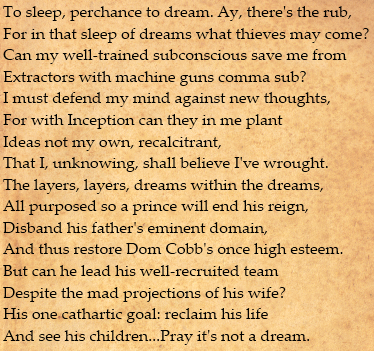
Sooo, that pretty much sums up Inception. Not quite sure what happened? Me either—I just felt like some lyric poetry might help obfuscate the plot in the same way the movie does. But don’t get me wrong, I love lyric poetry. It sounds amazing and looks cool, and when I understand it–which, thanks to being an English major, I often do (brushes off shoulder)–I feel like I’ve gotten even more out of it because it was a bit of a mind fuck. All that is to say: Inception is confusing, but in all the best ways. At the end, you’re left with an image that leaves everything up for debate, and if you have a fun group of friends, debate it you will.

Christopher Nolan manages to do something very impressive with this movie. Somehow, he is able to simultaneously achieve greatness in multiple genres. It’s right up there at the top of the twisty, psychological genre with Memento (one of Nolan’s other great films), Mulholland Drive, American Psycho and the like. It doesn’t tie up nearly as neatly as something like The Usual Suspects, but somehow it’s also very easy to follow, for Nolan works in plenty of explanation of his world in a way that doesn’t feel pedantic.  By having Dom Cobb (Leonardo DiCaprio) and his team explain everything to the team’s dream architect Ariadne (Ellen Page), we’re allowed to learn the mechanics of shared dreaming right along with her. There may be some unexplained bits, but I didn’t catch most of those until a second viewing, giving this movie a great deal of both initial enjoyment and rewatchability.

Besides just messing with your brain, Inception is a great action flick. One of the fight scenes takes place in zero gravity and is absolutely mind-blowing. I couldn’t keep myself from gasping, whispering “whoa,” and generally annoying the people around me—it was so cool. Amazing that Nolan can invent new ways to astonish despite all the movies that have come before. The action, for the most part, is handled very well. The effects are stunning and made even more impressive because the reason for their existence is so well-explained.  Sometimes, the film drags because so many different things are happening at once, but it’s well worth it, for at the cost of rapid-fire action, we gain a very interesting character arc. To tie down the story with something relatable, we get Dom Cobb’s relationship with his wife. His guilt surrounding her death haunts him, and his subconscious version of her constantly works to subvert his goals, at times almost costing the characters their lives. Action, an interesting character-based story, and mind-blowing psychological experiences all in one! Definitely worth ten bucks.

But that’s not all! One of my favorite things about Inception is its commentary on movies. Everything about this film is meta. There are dreams within dreams within dreams, and much of the film is actually talking about itself. At one point, Cobb explains to Ariadne that in order to tell if you’re in a dream, you simply need to try to remember how you got to where you are. In dreams, we apparently start in the middle and never know what came just before. This is also true of movies. We cut from scene to scene, leaving out much of the travel. In fact, the very scene I’m talking about starts with the two characters in a café, and the audience is not in the slightest bit disturbed by how they might have gotten there. Also, through the power of dreams, the film is able to have action scenes in whatever settings they want. Basically, each dream is a movie. Cobb tells Ariadne that dream architecture is incredible because you can build cities that have never existed. Her job is virtually that of a director, screenwriter, and CGI artist in one. Creating movies is creating a dreamworld, but instead of making a world for one dreamer, Hollywood makes worlds for a worldwide audience. In fact, to watch Inception is to experience inception, for everyone who has seen the movie has had the idea of implanting ideas in people implanted in them. Trippy, right?

This movie is well acted, well written, and well directed. Rarely am I so far out on the edge of my seat, and rarely does my brain work so furiously. Go see it. Go see it soon. And then go see it again.

5/5¢

Written by Russ Nickel

3 Comments

Filed under Review

The Inception Trilogy!

Christopher Nolan is far too classy to discuss this himself, but the powers that be at Warner Bros. are undoubtedly racing furiously to figure out how to milk everything they can out of the creative masterpiece that is Inception. Since all lucrative film epics come in threes, I decided it would be fun to speculate on the ways we can expect our fond memories of this movie to be bastardized in the years to come.

Inception II: Deception

Three years after the events in Inception, Dom Cobb (DiCaprio) is a happy single father working as a dream researcher. But someone doesn’t want the world’s greatest dream thief out of the game that easily. They kidnap his children and blackmail him into doing one last job: to convince Miles (Michael Caine) to release the patent on his invention, a dream machine that can connect all of mankind’s subconscious to a collective limbo. But is any of it real? Or is Cobb in a dream of his own devising? Ellen Page and Joseph Gordon-Levitt return as a dream-hopping super spy couple with a dark secret.

Inception III: Conception

Cobb (DiCaprio) averted disaster and saved his family in the last film, but he has unwittingly released a startling new technology on the world: the ability to enter dreams wirelessly. Now dream hoppers everywhere are gearing up subconscious armies for all-out war. Everyone wants control of the dream-world, and Cobb’s mind is ground zero for the battle. Cobb, Arthur (Gordon-Levitt) and Ariadne (Alexis Bledel) have the ability to stop it, but the dream world isn’t enough this time. With the help of energy tycoon Saito (Chow Yun-Fat), they have to find the dream hoppers in the real world, and bring them to justice.

This would bring the whole series to a nice, explosive conclusion. But of course, that’s never enough…

Inception IV: Reception (Written and directed by Brett Ratner)

Cobb (Hayden Christensen) is the Chief of Dream Police, the organization that regulates “Heaven”, the shared psychic space between all of humanity.  During a routine sweep of an unconstructed area, Cobb is contacted by an alien consciousness with dream-constructing powers unlike anything he’s ever experienced. How will mankind respond to these creatures from outer space visiting their dreams? Are they benevolent, or will they brainwash everyone on Earth in their sleep? Will Ariadne and Arthur’s marriage go off without a hitch? Does any of this make any sense? No one knows!

3 Comments

Filed under Feature

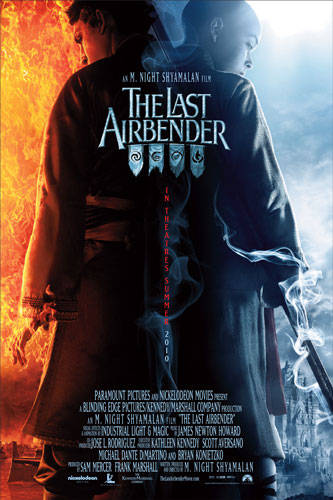
The Last Airbender – Worst Film of All Time!

Let’s start with the basics. The Last Airbender has absolutely no redeeming qualities. None! And believe me, I searched. This is coming from someone who loves G.I. Joe—I don’t really need quality drama in movies, but I do need something. Even hot girls and explosions are usually enough to entertain my rather muddled brain, but nooo, Shyamalan wouldn’t even give me those.

First, there’s no comprehensible plot. Somewhere, mired in the murky depths of this disaster is a tale about a young child, Aang, who, after being trapped in a ball of ice for a century, is both the last airbender and the Avatar, a chosen one who maintains peace. Through an uninteresting series of events, he befriends Katara, a waterbender, and her brother Sokka. They go around and do some stuff, and Aang tries to display some emotions. There’s some evil firebenders, including a banished prince with mercurial motivations, but Aang eventually defeats a small portion of them.

In all honesty though, the characters mostly just wander from location to location simply announcing their intentions. For example, here’s a painfully close to direct quote: Sokka: “Aang, should we go from town to town freeing people and therefore starting a rebellion?” Aang: “Yes, we should.” The characters proceed to do this so-called freeing, but we don’t really get to see it, and it never comes into play ever again. Ever! There’s not really much of an overarching goal for our heroes, so it’s hard to determine why they’re doing what they’re doing, and we can’t really foresee the repercussions of their actions, so every scene is pretty much tension free. The only real objective they have is to defeat those evil firebenders, and our merry crew comes painfully short of achieving even that.

Rather than show us scenes that either explain what’s happening, develop characters, or even just look cool, Shyamalan chooses to include a narrator who simply skips over important bits. “We arrived at the city and soon the princess and my brother became close friends.” Then again, maybe this was Shyamalan’s best choice. He probably realized the acting was so atrocious that there’d be no way Sokka and Princess Yue could possibly have any chemistry. Their only scene together before  (there’s really nothing to spoil so I won’t put a spoiler alert—just don’t see this movie) her death is really just a way to get across more exposition. Sokka: “My grandma would say your hair is odd.” Princess Yue: “I would tell her that it is odd because THREE MINUTES OF EXPOSITION.” I have to commend Seychelle Gabriel though. Her death scene is somehow touching, or at least, I was impressed at how close to touching she was able to make it. It feels sort of silly to have her tell Sokka that she’ll miss him more than he’ll ever know when we’ve never even seen them speak, especially when we’d only met her ten minutes before and our meeting was just some narration, but then again I guess Katara did tell us that they became “friends” and we all know what that means. Somehow, I still wasn’t buying it. Anyway, after the movie, we all agreed that her 1 minute in the limelight was the best part of the whole thing.

Plot and acting aside, the movie still could have been great. Sure I’d rather have those two things, but if Michael Bay has taught us anything, it’s that if you throw in gorgeous special effects, giant explosions, and hot girls, you have a recipe for success. Unfortunately, as I said earlier, this sad excuse for cinema lacked all three. The effects were lousy and, more importantly, relatively rare. Maybe the princess was hot, but these kids are all, well, kids (at least they’re supposed to be), so I can’t really talk about it without wanting to cleanse myself. Or at least pretending that I want to cleanse myself so that society will accept me. This movie advertised itself as an awesome fantasy epic filled with special-effects-driven action. Cool action that was a battle of the elements, something we don’t see too often. Instead, there were under two minutes of action in the entire film, give or take. TWO MINUTES!!! If they just cut most of the horrible exposition away and turned it into action, this would be a fun, albeit non-oscar-worthy movie. Did the bad guy have a cool death? Psh, no way. Four random waterbenders we’ve never seen before lift him into the air and drop him. Cooool. Did Aang do something awesome and unexpected at the end? Psh. He’d just learned to bend water, and a dragon spirit told him to use his new bending power and show the firebenders water, so it came as very little surprise when Aang made a giant wave to destroy scare away the enemies. That’s right. They simply flee when they see the wave. Ahhh, scary! Side note: I know it’s part of the show, but I don’t understand how the firebenders are so powerful when wind dissipates fire, earth blocks fire, and water douses fire. I mean, it’s clearly the worst element.

On another side note, the teaser trailer where Aang is blowing out candles when faced with an oncoming army of thousands of ships was what made me want to see this movie in the first place. “Wow!” I thought. “However will he get out of this situation? I can’t wait to see.” Too bad I’ll never get to see because it never comes up. They fooled me!

Finally, one last example to, err, exemplify what makes this movie so bad: At the very beginning, the words “Book One: Water” flash on the screen, and it wasn’t until about ¾ of the way through the movie that anyone I went with finally decided that we weren’t going to see all the books in one movie. The plot was so beyond us, or maybe below us, that we still thought they might wrap up books 2 and 3 in about 15 minutes, you know, montage style, or, more likely, in a beautiful piece of narration: “And so Aang mastered both earth and fire, thus defeating everyone. The end.” If this makes enough money to spawn sequels that I have to go watch, I’m going to cry myself to sleep. It made it into my bottom 10 movies list.

So please, if for some god-forsaken reason you have to watch The Last Airbender, do yourself a favor and go on a good old fashioned regular bender before you submit yourself to this.

.5/5 stars

Alignment: Unbearable Crap

Written by Russ Nickel

16 Comments

Filed under Review

LIST :: THE 51 UNITED MOVIES OF AMERICA

/* The best movie set (at least partially) in each U.S. state, or maybe my favorite one, or maybe the one that best captures the spirit of that state. Or, when I haven’t seen any movie from that state, the one that’s supposedly the best. What have you. */

// Happy birthday, America.

Alabama :: Forrest Gump

Alaska :: Into the Wild

Arizona :: Little Miss Sunshine

Arkansas :: Sling Blade

California :: Pulp Fiction

Colorado :: South Park: Bigger, Longer & Uncut

Connecticut :: Amistad

Delaware :: Fight Club

District of Columbia :: Minority Report

Florida :: Adaptation.

Georgia :: Gone with the Wind

Hawaii :: Forgetting Sarah Marshall

Idaho :: My Own Private Idaho

Illinois :: High Fidelity

Indiana :: Close Encounters of the Third Kind

Iowa :: Field of Dreams

Kansas :: Superman

Kentucky :: The Insider

Louisiana :: The Green Mile

Maine :: The Shawshank Redemption

Maryland :: Twelve Monkeys

Massachusetts :: Jaws

Michigan :: True Romance

Minnesota :: A Simple Plan

Mississippi :: O Brother, Where Art Thou?

Missouri :: The Day After

Montana :: Star Trek: First Contact

Nebraska :: Boys Don’t Cry

Nevada :: The Godfather, Part II

New Hampshire :: What About Bob?

New Jersey :: Clerks

New Mexico :: Independence Day

New York :: The Godfather

North Carolina :: Cold Mountain

North Dakota :: Fargo

Ohio :: Traffic

Oklahoma :: Thelma and Louise

Oregon :: One Flew Over the Cuckoo’s Nest

Pennsylvania :: Rocky

Rhode Island :: Dumb and Dumber

South Carolina :: The Patriot

South Dakota :: North by Northwest

Tennessee :: The Client

Texas :: No Country for Old Men

Utah :: Indiana Jones and the Last Crusade

Vermont :: Dead Poets Society

Virginia :: The Bourne Identity

West Virginia :: Donnie Darko

Washington :: 10 Things I Hate About You

Wisconsin :: Dawn of the Dead (2004)

Wyoming :: Unforgiven

Leave a comment

Filed under Feature

Welcome!

Welcome to The Nickel Screen! Like ‘the silver screen,’ only a similar transition metal instead. Named after our founder Russ Nickel and established in July 2010, The Nickel Screen endeavors to bring you the most intriguing*, most provocative*, and wittiest* commentary on the arts* of motion pictures, television, and entertainment.

Written by a crack squad of three screenwriters out of the San Francisco Bay Area, 5¢S will undoubtedly be your next home page, provided you are a compulsive list-maker with a penchant for disputing heatedly the irrelevant opinions of others.

*Results may vary.

1 Comment

Filed under Administrative